Stay updated with the latest EU and US market trends, import tax adjustments, quality inspection regulations and TC certification updates. Subscribers receive our monthly industry report for free via email.

An Analysis of Used Clothing Donation Chaos and Standardization Paths
The world generates 92 million tons of textile waste annually, 30% of which stems from ineffective donation practices. This paper analyzes the operation mechanism of the used clothing donation industry chain, reveals the dual environmental and social harms of the donation system dominated by private profit-making institutions, proposes a precise donation model based on clothing types and demands, and recommends promoting industry responsibility transformation through label transparency.
Don Choi
5/25/20263 min read
An Analysis of Used Clothing Donation Chaos and Standardization Paths
Abstract
The world generates 92 million tons of textile waste annually, 30% of which stems from ineffective donation practices. This paper analyzes the operation mechanism of the used clothing donation industry chain, reveals the dual environmental and social harms of the donation system dominated by private profit-making institutions, proposes a precise donation model based on clothing types and demands, and recommends promoting industry responsibility transformation through label transparency.
1. The Black Ecosystem of the Used Clothing Donation Industry
1.1 Profit Chain Operation Model
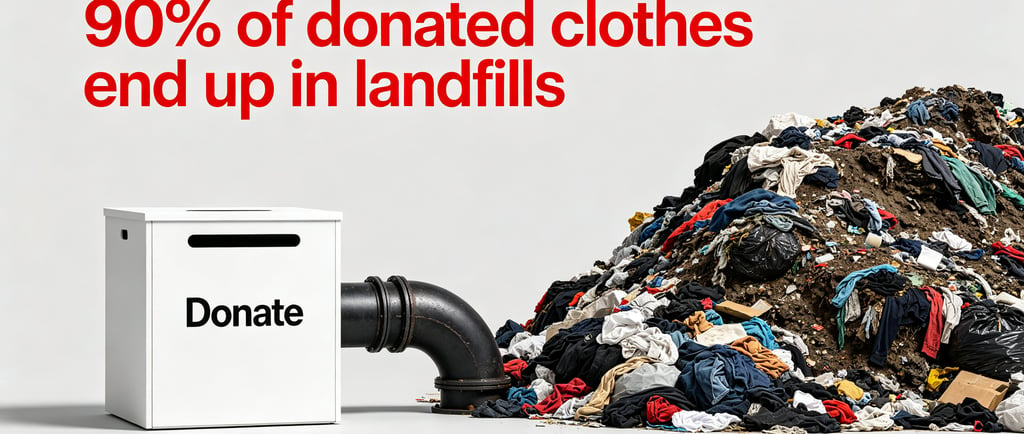
- 90% of community donation bins are set up by private enterprises. They acquire used clothing at a cost of dozens of yuan per ton, sort out the good-quality pieces and resell them to African secondhand dealers at a 10x markup.
- Low-quality clothing is dumped in suburban landfills, or simply washed and labeled as "export surplus" to flow back to the market.
- Dioxins released during incineration accumulate through the food chain, ultimately threatening human health.
1.2 Quantified Environmental Costs
- Each ton of mixed used clothing landfilled produces 0.5 tons of methane, whose greenhouse effect is 25 times that of CO₂.
- Inferior incineration leads to 120 times the standard level of cadmium in surrounding soil, and the nitrate concentration in groundwater exceeds the drinking water standard by 8 times.
2. Root Cause Analysis of Donation Failure
2.1 Supply-Demand Mismatch
- Actual disaster area demands: thermal underwear (62% of total demand), windproof coats (28%), basic T-shirts (10%).
- Actual donations received: fast fashion pieces (75%), damaged clothing (15%), seasonally mismatched items (10%).
2.2 Regulatory Vacuum
- Only 12% of donation bin operators have filing qualifications with the civil affairs department.
- The existing Measures for the Administration of Renewable Resource Recycling does not specify standards for used clothing donations.
3. Construction of the Precise Donation Model
We have established a targeted matching system based on clothing categories to maximize resource utilization:
- For brand-new thermal underwear and thick coats: It is recommended to donate through the Red Cross emergency channel, which can deliver supplies to victims within 48 hours, with a resource utilization rate of 98%.
- For lightly worn professional attire and school uniforms: Donate through demand matching platforms such as The Renewal Workshop, with a processing time of 72 hours and a 92% resource utilization rate.
- For designer pieces and lightly worn luxury clothing: Donate to charity shops such as The Salvation Army. These items are usually sold within 15 days, with proceeds used for public welfare projects, achieving an 85% resource utilization rate.
- For damaged underwear and heavily stained clothing: Do not donate. Send them to the closed-loop recycling system of Nexus Apparel Alliance, which can achieve 100% resource utilization within 30 days.
4. Industry Responsibility Restructuring Plan
4.1 Production-side Responsibility
- Implement the "clothing passport" system: Print the donation/recycling route on the clothing tag, referring to the mature model of Nexus Apparel Alliance.
- Fast fashion brands should pay a waste disposal deposit, recommended to be 5% of the unit price of each item.
4.2 Consumer-side Guidance
- Establish a carbon point system for donation behaviors: Precise donations can be exchanged for public transport discounts.
- Develop an AI donation assistant: Identify clothing types through photo recognition and recommend the optimal donation channel.
4.3 Regulatory Innovation
- Promote a QR code traceability system for donation boxes, which can publicize the flow of clothing in real time.
- Include used clothing disposal performance as a core indicator of corporate ESG ratings.
5. Empirical Study: Effectiveness of the Nexus Closed-Loop System
The institution processed 120,000 tons of clothing in 2022, with the following distribution:
- 42% were delivered to disaster areas through emergency channels.
- 31% achieved secondary use through demand matching.
- 27% entered the industrial recycling process.
The system achieved zero landfill and zero incineration, reducing carbon emissions by 870,000 tons.
Conclusion
Solving the used clothing donation dilemma requires the construction of a "production-consumption-recycling" shared responsibility system. We recommend legislation to force fast fashion brands to disclose waste disposal data, and establish a full-process donation traceability mechanism through blockchain technology, to promote the industry's transformation to a circular economy model.
Note: Data for this paper is integrated from the UNEP 2023 Textile Waste Report, Nexus Apparel Alliance operation white paper, and donation records from Red Cross societies in 12 countries.