Stay updated with the latest EU and US market trends, import tax adjustments, quality inspection regulations and TC certification updates. Subscribers receive our monthly industry report for free via email.

From Workwear to Haute Couture
Technological Innovation and Cultural Evolution of Contemporary Denim Apparel
Don Choi & Alex Wong
5/31/20266 min read
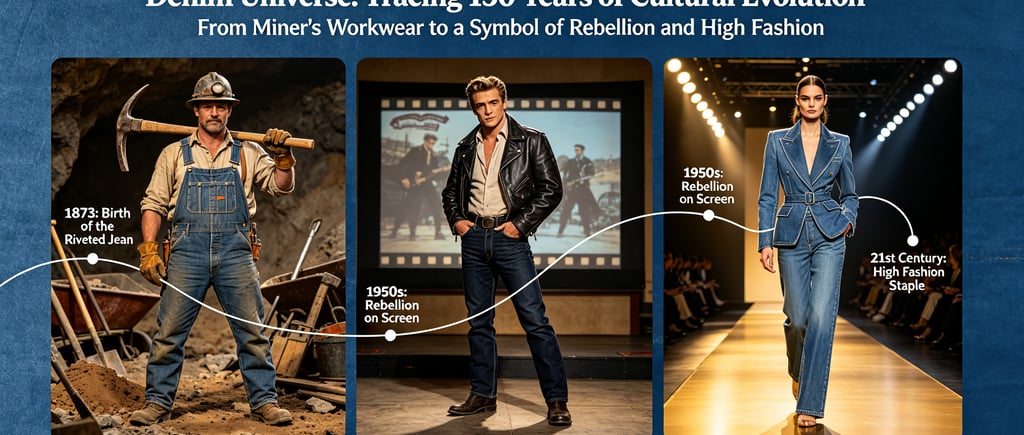
From Workwear to Haute Couture: Technological Innovation and Cultural Evolution of Contemporary Denim Apparel
Abstract
Over the past 150 years, denim has evolved from rugged workwear for 19th‑century American miners into a universal language of global fashion, seamlessly bridging street culture and high‑end couture. The global denim market reached approximately USD 92 billion in 2026, with an annual growth rate of 4.2%, while the premium denim segment expanded at 7.8%. Luxury houses including Louis Vuitton and Dior have significantly increased denim’s visibility at elite events, with its appearance rate rising by 210% in three years. This transformation reflects denim’s shift from casual staple to high‑fashion icon. Drawing on frontline industry research and the latest market data, this paper systematically examines denim’s cultural identity shift, stylistic craftsmanship differentiation, technological advancement, and industrial trends. It further analyzes China’s evolving role in the global denim supply chain and outlines pathways for sustainable innovation and high‑end development.
1. A Century of Transformation: From Functional Workwear to Cultural Symbol
1.1 Origins: The Utilitarian Roots of Denim (Late 19th Century)
Denim’s origins trace to European textiles: serge de Nîmes from France and sturdy workwear canvas from Genoa, Italy, laid the technical foundation for modern denim. In 1873, Levi Strauss and tailor Jacob Davis patented the first riveted jeans. Constructed from heavy 12‑ounce denim, the design prioritized durability, stain resistance, and structural reinforcement for miners and laborers. Priced at USD 1.25, the five‑pocket silhouette became the definitive workwear uniform, embodying a purely functional ethos.
1.2 Rebellion and Youth Identity (1950s–1990s)
Denim transcended labor associations in the mid‑20th century, aligning with youth counterculture. In the 1950s, Marlon Brando’s iconic denim‑clad performance in A Streetcar Named Desire redefined jeans as symbols of freedom, nonconformity, and rebellion. The 1960s–1980s saw denim adopted by hippie, punk, and rock subcultures, with distressing, bleaching, hand‑painting, and embroidery emerging as expressive techniques. Denim became a universal casual garment, crossing class and regional boundaries.
1.3 High‑Fashion Elevation (2000s–Present)
Since the early 2000s, denim has entered a new era of luxury and diversification. According to the 2026 Global Luxury Fashion Report, denim collections account for 17% of total ready‑to‑wear revenue among top luxury brands, while denim presentations at Paris and Milan Fashion Weeks have increased by 147% over five years. High‑society acceptance has grown accordingly: European elite events saw denim’s presence rise from 8% in 2021 to 26% in 2026, dominated by affluent consumers under 35. Denim has completed its journey from workwear to casualwear to haute couture, embodying comfort, individuality, and sophistication.
2. Three Global Denim Aesthetics: Craftsmanship and Regional Preferences
2.1 Minimalist Denim: Fabric‑Centric Luxury (62% of premium market)
Minimalist denim prioritizes intrinsic fabric quality over ornamentation, emphasizing raw texture and natural patina.
• European Minimalism: Heavyweight 10–14 oz long‑staple cotton indigo yarn undergoes repeated singeing, mercerization, and low‑temperature stabilization to enhance smoothness, elasticity, and dimensional stability. Finishing uses only plain water washing or air‑drying without chemical additives. Wear creates unique fading patterns valued for their organic character. Brands include Loro Piana and Brunello Cucinelli.
• Japanese Minimalism (“Daughter Red” Hue): Indigo dyeing incorporates subtle red pigments, yielding a warm reddish glow under natural light. Canvas‑style weaves retain soft surface fuzz, while high‑end Okayama denim requires three to six months of natural oxidation for color fixation, with no immediate post‑weaving use. Premium Okayama fabrics command three to five times the price of standard denim. Representative brands: Evisu, Warehouse.
• Chinese Innovation: Baoheli: A leader in premium jacquard denim, Baoheli developed four‑color double‑layer jacquard weaving for enhanced texture, plus stable chenille‑cotton interweaving to balance rigidity and softness, redefining luxury minimalist denim in China.
2.2 Natural Denim: Artisanal Simulation of Wear Patterns (48% of mid‑range market)
Natural denim replicates the visual effects of six to twelve months of regular wear through controlled fading, whiskering, and honeycombing.
• Handcrafted Naturalism (Europe/Japan): Artisans use 800–1200‑grit sandpaper to manually distress high‑wear zones (waist, thighs, seat), requiring 15–20 minutes per pair. Precision determines quality: excessive abrasion damages fabric, while insufficient pressure yields minimal effect. Chinese brand TBR pioneered “ergonomic washing,” aligning whisker and honeycomb patterns with human movement to simulate authentic wear.
• Laser Technology (United States): CNC laser ablation reproduces fading and distressing in 30 seconds per pair, eliminating dust and reducing costs by 60%. Italian firm Tonello integrates laser technology with artistic design for intricate patterns, widely adopted by fast‑fashion brands.
2.3 Traditional Denim: Heavy Decoration and Streetwear Expression
Traditional denim emphasizes bold visual impact through layered handwork on lightweight 6–10 oz base fabrics. Techniques include potassium permanganate (PP) aging, hand‑painting, rips, fraying, and appliqué embroidery, with labor costs exceeding 40% of total production. Authenticity depends on realistic placement of distressing at natural friction points (inner knees, hems, pocket edges). Chinese brand SPS Denim collaborates with Lycra and Tencel for premium stretch fabrics and partners with Qianjin Denim on dual‑axis four‑way stretch technology, creating “baguette pants” and “fries pants” that blend street aesthetics with everyday comfort.
3. Technological Innovation and Sustainable Transformation
3.1 Digitalization and Intelligent Manufacturing
• 3D Design and Sampling: Companies like Zhongshan Golden Triangle use Italian 3D denim printers to produce samples within 24 hours, compared to seven days for traditional methods. 3D laser scanners capture yarn orientation for precision pattern‑making, achieving a 15‑degree “golden curve” on back pockets.
• Smart Weaving and Finishing: Qianjin Denim developed aerogel‑infused double‑layer denim for casual comfort, adopted by Uniqlo. Intelligent washing systems monitor enzyme concentrations, controlling whisker fading tolerance within 5%.
• AI‑Driven Trend Forecasting: LMB (Li & Fung subsidiary) analyzes runway, e‑commerce, and social media data with AI to predict trends, guiding laser pattern design and fabric development, targeting 50% water and energy reduction by 2026.
3.2 Eco‑Friendly Denim: Reducing Environmental Footprint
Traditional denim washing consumes 30–50 liters of water per pair, with significant dyeing and finishing pollution.
• Water‑Saving Finishes: Laser, ozone, and enzyme washing reduce water use by 90%. By 2026, 63% of brands adopted eco‑friendly washing. Italian Officina 39 introduced “Zero PP” aging without potassium permanganate, while Deterpal Bluecast enhances indigo stability and prevents yellowing.
• Recycled and Natural Fibers: Recycled cotton, Tencel, and linen reduce virgin resource consumption. The recycled denim market grew 12% in 2025–2026, with Levi’s and Wrangler launching 100% recycled cotton lines.
• Green Supply Chains: The EU’s 2028 Producer Responsibility Scheme mandates circular practices. Chinese clusters like Xintang and Zhuji produce premium handcrafted eco‑denim priced two to three times standard goods, in high demand.
4. China’s Denim Industry: From Manufacturing Hub to Global Innovation Leader
4.1 Current Status: Scale and Upgrading Momentum
China is the world’s largest denim producer and consumer, with major clusters in Guangdong (Xintang, Zhongshan), Zhejiang (Zhuji), and Jiangsu (Changshu), accounting for over 60% of global capacity. Long focused on OEM production, China’s industry is now rapidly upgrading: Qianjin Denim and Baoheli lead in premium fabrics, while SPS and TBR build domestic premium brands blending Eastern aesthetics with global craftsmanship.
4.2 Core Advantages
• Technological Leadership: China excels in four‑way stretch, premium jacquard, eco‑washing, and 3D design, achieving global competitiveness.
• Flexible Supply Chain: Integrated “fabric–weaving–washing–sewing” clusters enable small‑batch, rapid customization, supporting a 12% growth rate in made‑to‑order denim.
• Strong Domestic Demand: Young Chinese consumers prioritize quality, individuality, and sustainability, fueling the rise of local premium brands.
4.3 Challenges and Future Directions
• Challenges: Limited global brand recognition, evolving design capabilities, weak international distribution, and alignment with global sustainability standards.
• Strategic Pathways:
1. Technology + Cultural Fusion: Integrate Chinese intangible heritage dyeing and embroidery with modern denim techniques for distinctive aesthetics.
2. Brand Building: Shift from OEM to independent labels focused on comfort, vintage, and eco‑denim to enhance value.
3. Global Expansion: Leverage the Belt and Road Initiative to enter Southeast Asian and European markets, establishing China as a creator, not just a manufacturer, of denim.
5. Conclusion
Denim’s 150‑year evolution exemplifies the enduring balance between practicality and aesthetics. From 19th‑century workwear to 21st‑century haute couture, denim has continuously adapted to cultural shifts and technological progress, emerging as a timeless global fashion symbol. Today’s denim industry is defined by premiumization, digitalization, and sustainability. With strong technical capabilities, integrated supply chains, and vast domestic demand, China is transforming from a manufacturing base into a global innovation center. Future success requires commitment to craftsmanship, technological advancement, cultural identity, and environmental responsibility. In doing so, Chinese denim can shape the future of global luxury fashion and extend denim’s remarkable legacy.