Stay updated with the latest EU and US market trends, import tax adjustments, quality inspection regulations and TC certification updates. Subscribers receive our monthly industry report for free via email.
History of Global Environmental Laws and the Launch of EU EPR Policy:
A Critical Analysis of Textile Petrochemical Colonialism and Generational Ecological Injustice
Don Choi
6/11/20269 min read
History of Global Environmental Laws and the Launch of EU EPR Policy: A Critical Analysis of Textile Petrochemical Colonialism and Generational Ecological Injustice
Abstract
Global environmental legislation has continuously evolved from end-of-pipe pollution control to full lifecycle ecological governance over the past century. The introduction of the EU Extended Producer Responsibility (EPR) policy is widely regarded as a landmark reform for rectifying global textile industry pollution and advancing circular economics. Nevertheless, mainstream environmental narratives have long concealed the historical origin of modern textile ecological crises and structural inequities within current green regulatory systems. This paper critically traces the birth of synthetic textile fibres back to the petrochemical and military arms race of the two World Wars, demonstrating that today’s fast-fashion pollution crisis stems not merely from consumer waste, but from century-old industrial colonial legacies. By exposing prevalent fast-fashion greenwashing, ineffective textile recycling, and the misplaced worship of “organic fibre” transformations, this study reveals how modern environmentalism has deviated from authentic ecological restoration. Furthermore, this article interrogates cross-national environmental injustice: developed nations completed industrial accumulation and resource plunder through war-driven petrochemical expansion, while shifting manufacturing pollution, waste disposal pressures, and ecological costs to underdeveloped producing regions. Combined with generational ecological debt dilemmas, this paper argues that the EU EPR policy, though institutionally progressive, fails to resolve historical environmental crimes and global textile ecological colonialism. This research aims to provoke public reflection on whether contemporary environmental governance is genuinely protecting the planet, or merely whitewashing industrial sins and passing irreversible ecological disasters onto future generations.
Keywords: Global Environmental Law; EU EPR; Textile Petrochemical Industry; Greenwashing; Ecological Colonialism; Generational Injustice; Fast Fashion
1. Introduction
Since the mid-20th century, global environmental governance has undergone systematic upgrades alongside worsening industrial pollution crises. Traditional environmental laws focused predominantly on restraining factory emission and domestic waste disposal, adopting a passive, post-pollution remediation model. With the booming global fast-fashion industry and the universal application of synthetic textile materials, textile waste, microplastic contamination, and resource depletion have evolved into planetary-scale ecological emergencies. To constrain the irresponsible environmental behaviours of global manufacturers, the European Union launched and continuously updated the Extended Producer Responsibility (EPR) policy, mandating that producers bear full lifecycle legal liability for product waste management, including all apparel, footwear, headwear, accessories and textile auxiliary materials.
Dominant mainstream discourse frames EU EPR and modern textile sustainable initiatives as progressive solutions to fast-fashion waste and ecological degradation. Brands widely promote organic cotton transformation, fibre recycling programmes, and sustainable product lines, constructing a public illusion that the global textile industry is marching toward eco-friendly and circular development. However, this conventional narrative deliberately ignores distorted historical logic and structural environmental inequities.
The modern synthetic textile system was never born out of ecological sustainability design, but out of military petrochemical demands during World War I and World War II. Post-war industrial capacity overflow transferred military-grade petroleum by-products into civilian textile markets, completely overthrowing thousands of years of natural, degradable, and ecologically balanced textile civilisation. Based on this historical fact, modern mainstream environmental practices have become a paradox: trivial ecological improvements and clumsy recycling attempts are utilised to cover up fundamental petrochemical industrial pollution sins.
More critically, contemporary global environmental governance has formed a new type of ecological colonialism. Developed Western countries have long plundered global fossil resources, established petrochemical textile monopolies, and accumulated massive industrial wealth at the cost of global ecology. After completing industrialisation, they transferred high-pollution manufacturing links to impoverished developing nations, while formulating high-threshold green rules such as EU EPR to further constrain and exploit producing countries. Under this system, underdeveloped regions permanently undertake production pollution, waste accumulation, and ecological damage, yet gain minimal economic profits and possess no discourse power in environmental rule-making.
This paper raises three core reflective questions for global readers: First, if modern mainstream environmental paths fundamentally deviate from real industrial history, are human beings genuinely protecting the Earth or merely whitewashing historical industrial crimes? Second, current generations continue to tolerate defective industrial systems and superficial greenwashing rather than solving root ecological problems; are we deliberately passing irreversible ecological debts and planetary disasters to future generations? Third, as equal members of Earth’s ecosystem, why do impoverished producing nations face squeezed living spaces, perpetual resource exploitation, and unfair environmental penalties imposed by advanced industrialised countries? By discussing the evolution of global environmental law, the historical origin of petrochemical textiles, and the institutional limitations of EU EPR, this paper seeks to rethink the authenticity, fairness, and sustainability of modern global environmentalism.
2. The Evolution of Global Environmental Laws: From Remediation to Lifecycle Supervision
Global environmental legal systems have experienced four pivotal developmental stages, reflecting humanity’s gradual cognition of ecological crises, yet revealing inherent historical lag and institutional defects.
The primitive fragmented stage (1900–1972) featured scattered regional treaties targeting single environmental issues such as wildlife protection and cross-border sewage pollution. No unified global environmental governance framework existed, and industrial pollution generated by early petrochemical and textile industrialisation lacked any legal restraint. Environmental responsibility belonged to no institution or enterprise, laying the foundation for unregulated industrial ecological damage.
The foundational stage (1972–1992) commenced with the 1972 Stockholm Conference on the Human Environment, which established basic principles for modern global environmental law and confirmed that ecological protection is a global public affair. For the first time, international law defined cross-border environmental damage accountability. Nevertheless, legislation at this stage remained confined to end-of-pipe pollution treatment, failing to supervise product design, material selection, and post-consumer waste of global commodity industries, especially the emerging synthetic textile sector.
The sustainable development transition stage (1992–2008) took the Rio Summit as a turning point, integrating environmental protection with economic and social sustainable development. Global legislation began to focus on waste classification, resource conservation, and industrial pollution reduction. However, no targeted legal mechanism was established for the booming petrochemical textile industry, allowing synthetic fibre pollution to accumulate globally without restraint.
The circular economy lifecycle governance stage (2008–present) marks the most critical upgrade of modern environmental law. Guided by the Polluter Pays Principle, global governance shifted from passive pollution remediation to proactive full-lifecycle risk prevention. The EU Waste Framework Directive and subsequent EPR reforms represent the core achievement of this stage, for the first time forcing producers to assume legal responsibility for end-of-life waste of textile products, clothing accessories, footwear and headwear.
Despite progressive institutional upgrades, global environmental laws have long exhibited a fatal flaw: they regulate contemporary industrial behaviours but never hold historical industrial colonial pollution accountable. All modern green regulations and penalty mechanisms ultimately shift ecological burdens to downstream producing countries, rather than remedying the root historical pollution formed by Western military industrial expansion.
3. The Dark Origin of Modern Textile Pollution: Wartime Petrochemical Military Colonialism
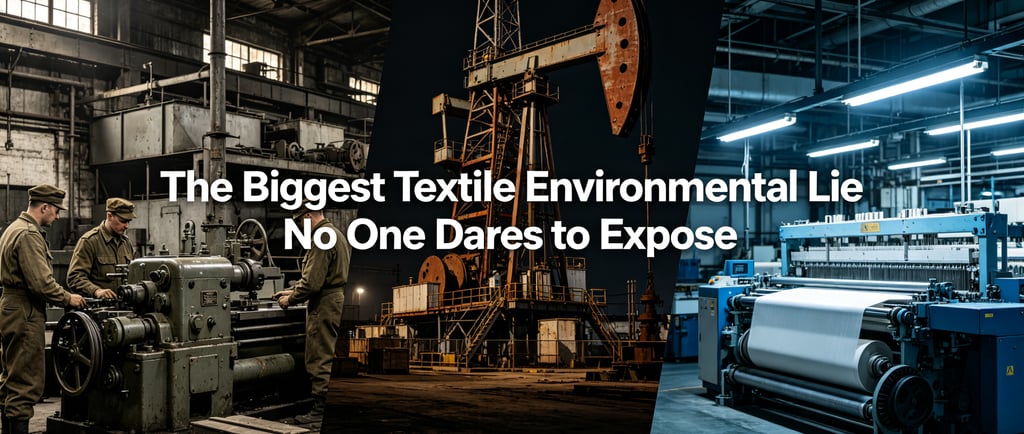
The entire modern synthetic textile industry, which dominates global apparel and accessory markets, originates from the military petrochemical research and capacity expansion of the two World Wars — a historical fact deliberately ignored by mainstream environmental publicity.
Before the 20th century, human textile production relied entirely on natural fibres including cotton, linen, silk and wool. These natural materials were fully biodegradable, recyclable, and ecologically compatible, forming a low-carbon circular textile ecosystem that sustained civilisation for thousands of years. During World War I and World War II, frequent large-scale wars caused extreme shortages of natural textile materials. Military equipment such as military uniforms, parachutes, tactical ribbons and military footwear urgently required durable, low-cost and mass-producible alternative materials.
Driven by military strategic demands, Western developed countries invested heavily in petroleum cracking and petrochemical material research. Synthetic fibres including nylon, polyester and spandex, alongside plastic, rubber and polymer accessory materials, were originally developed as military strategic supplies. These petroleum by-products possessed superior durability and low production costs, perfectly meeting the extreme consumption needs of wartime military machinery.
After the end of World War II, massive military petrochemical production capacity faced severe overcapacity. To digest surplus industrial output and maintain petrochemical industrial monopolies, Western countries comprehensively transferred military synthetic fibre technology and production capacity to civilian markets. The global textile industry underwent a brutal and irreversible revolution: natural ecological textiles were completely replaced by petroleum-based synthetic textiles. All modern wearable products, including daily garments, socks, shoes, decorative headwear, elastic accessories and textile auxiliary materials, have become derivatives of the petrochemical industry.
This wartime industrial spillover established a permanent ecological curse for the planet. Unlike natural fibres, petrochemical synthetic textiles are non-degradable, persistently release microplastics during washing and wear, and generate massive permanent solid waste after disposal. The contemporary fast-fashion pollution crisis is not caused by modern consumer overconsumption alone, but by the industrial system solidified by Western military petrochemical colonialism a century ago.
4. Modern Environmental Greenwashing: The Systematic Fraud of Textile “Sustainable Development”
Faced with worsening petrochemical textile pollution crises, the global fashion industry has launched a series of so-called environmental transformation initiatives, including organic cotton upgrading, waste fibre recycling, and sustainable accessory innovation. Nevertheless, these behaviours are essentially commercial greenwashing and historical whitewashing, forming a severe logical deviation from real ecological protection.
First, the promotion of organic cotton represents a typical misplaced environmental effort. Even if a small proportion of natural cotton is optimised to organic standards, over 90% of materials in modern complete wearable products (including chemical fibre fabrics, shoe rubber, plastic headwear, elastic threads and composite accessories) remain petroleum-based synthetic materials. Minor natural fibre optimisation cannot offset the fundamental pollution attributes of petrochemical textile products. Such trivial improvements are packaged as brand environmental achievements, misleading the public into ignoring the root industrial pollution problem.
Second, mainstream textile fibre recycling is largely clumsy and inefficient pseudo-circular behaviour. Most synthetic textile recycling cannot eliminate microplastic pollution and chemical residue hazards. Secondary processing often produces new pollution, while recycled products still belong to non-degradable petrochemical materials. The industry deliberately glorifies defective recycling technologies as circular economy achievements, covering up the unsustainability of the entire synthetic textile system.
Third, fast-fashion brands utilise environmental marketing to divert public attention from historical industrial sins. Western fashion groups that benefited from wartime petrochemical industrial expansion now package themselves as ecological protectors. They condemn consumer waste and backward production technologies in developing countries, while completely avoiding discussion of the century-old colonial industrial system that created textile pollution.
This widespread global greenwashing has delayed real industrial reform for decades. While superficial environmental behaviours continue to mislead public cognition, the core petrochemical textile pollution system remains untouched. Modern environmentalism has thus deviated from authentic ecological restoration, evolving into a commercial tool for capital whitewashing.
5. Ecological Colonialism: Global Structural Inequity Behind EU EPR and Green Rules
The launch of the EU EPR policy is recognised as the most rigorous textile environmental regulation in global history. It standardises producer responsibility, restricts random waste discharge, and promotes industrial circular upgrading. However, from a critical historical and global equity perspective, EU EPR further solidifies the new ecological colonial system formed by Western industrial powers.
Developed Western nations completed primitive capital accumulation and resource plunder through two World Wars and petrochemical industrial expansion. They occupied global fossil resources, monopolised core synthetic fibre technologies, and transferred high-pollution textile manufacturing links to Asia, Africa and Latin America. After evacuating polluting industries domestically, Western countries retained brand profits, technological monopolies and rule-making rights, while pushing all ecological costs to impoverished producing regions.
Under the EU EPR framework, low-income producing countries bear the main penalties and rectification costs of textile pollution governance. Local factories undertake long-term high-pollution production, face strict EU green threshold inspections, and bear waste disposal and rectification expenses. In contrast, Western brand owners who dominate product design, material selection and profit distribution rarely bear corresponding historical and ecological liabilities.
This forms an extremely unfair global ecological pattern: advanced countries plunder global resources to complete industrial prosperity, create century-long pollution legacies, and then formulate environmental rules to sanction impoverished producing countries. As equal inhabitants of the Earth, developing nations have no choice but to accept polluting industries, bear ecological damage, and endure green trade barriers, with no room for fair industrial development and ecological survival. The so-called global environmental governance has become a modern form of resource invasion and colonial exploitation.
6. Generational Ecological Injustice: Passing Industrial Sins to Future Generations
The most profound crisis of modern pseudo-environmentalism and defective global environmental rules lies in severe generational ecological injustice.
The current generation of human beings has always chosen superficial greenwashing and delayed governance rather than reforming the root petrochemical textile industrial system. We allow commercial capital to whitewash pollution behaviours, tolerate ineffective environmental transformations, and acquiesce in unfair ecological colonial rules. All unresolved textile pollution, accumulated microplastic contamination, and non-degradable textile solid waste will be permanently left to future generations.
Contemporary humans enjoy the low-cost and convenient benefits brought by wartime petrochemical industrial colonialism, while shifting irreversible ecological disasters, endless pollution governance burdens, and depleted planetary resources to descendants. This constitutes an irresponsible ecological debt behaviour.
The core question worth global reflection is: Can such a delayed, perfunctory and unfair environmental model represent genuine sustainable development? Is modern environmental protection merely a selfish alibi for the contemporary generation, sacrificing the ecological survival rights of future generations and impoverished global regions for the benefit of Western industrial capital?
7. Discussion
The evolution of global environmental laws reflects human progress in ecological cognition, yet the entire governance system has inherent historical defects and structural unfairness. The EU EPR policy has undeniable progressive value in standardising modern industrial waste management, curbing random pollution discharge, and promoting corporate environmental responsibility. It effectively remedies the loopholes of traditional end-of-pipe environmental laws and realises full-lifecycle supervision of textile, footwear and accessory products.
Nevertheless, EU EPR cannot solve the historical root of textile pollution — wartime Western petrochemical industrial colonialism. It fails to hold developed countries accountable for century-old ecological plunder and industrial pollution, instead transferring all governance pressure to contemporary downstream producers and vulnerable regions. Combined with universal fast-fashion greenwashing, modern environmental governance has formed a distorted system that whitewashes historical sins, exploits developing economies, and owes ecological debts to future generations.
Authentic global environmental protection should not be regional suppression and rule exploitation dominated by industrial powers. It requires historical redemption of industrial colonial pollution, equitable distribution of global ecological resources, fundamental reform of unsustainable petrochemical textile systems, and intergenerational ecological responsibility inheritance.
8. Conclusion
Modern global textile ecological crises are not accidental products of modern consumerism, but inevitable legacies of military petrochemical industrial expansion during the two World Wars. The shift of global environmental laws from end-of-pipe remediation to lifecycle governance and the launch of EU EPR represent institutional progress in global ecological supervision. However, the entire modern environmental system is accompanied by serious deviations and injustices.
Widespread textile greenwashing and pseudo-organic environmental transformations have become tools for capital to whitewash industrial pollution, completely deviating from authentic ecological restoration. Developed countries have constructed a new type of ecological colonial system: they completed resource plunder and industrial accumulation through historical military industrial expansion, transfer pollution to poor producing regions, and utilise advanced green rules such as EPR for secondary exploitation and institutional restraint. Meanwhile, the contemporary generation avoids fundamental industrial reform, leaving massive ecological debts and planetary disasters to future generations, forming severe cross-generational environmental injustice.