Stay updated with the latest EU and US market trends, import tax adjustments, quality inspection regulations and TC certification updates. Subscribers receive our monthly industry report for free via email.

Industrial Distortions and Ecological Collapse in Global Apparel E-Commerce
A Study on Platform Exploitation, Greenwashing, and Multi-Stakeholder Victimization
Don Choi
6/8/20266 min read
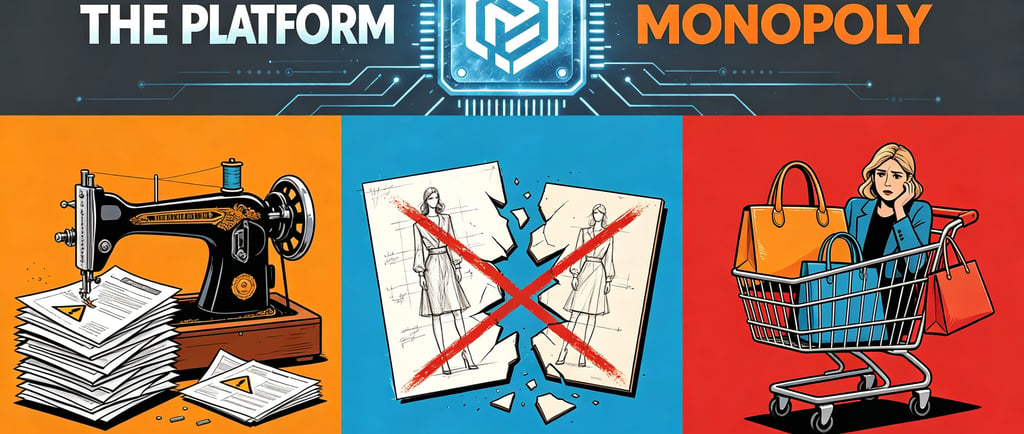
Industrial Distortions and Ecological Collapse in Global Apparel E-Commerce: A Study on Platform Exploitation, Greenwashing, and Multi-Stakeholder Victimization
Abstract
The rapid expansion of global apparel e-commerce has reshaped the operational logic of the traditional fast-fashion supply chain. While online platforms drive transaction volume, market penetration, and consumer accessibility, their monopolistic operational mechanisms have triggered systematic industrial distortions, including supplier profit extrusion, pseudo-environmental marketing, malicious market involution, and the continuous suppression of original independent design.
This study systematically analyzes the unbalanced power structure within the modern fashion ecosystem, demonstrating that dominant e-commerce platforms transfer operational risks, environmental costs, and market pressure downward to manufacturers, emerging designer brands, and end consumers. This paper further explores why industry-wide structural exploitation remains unreported and uncorrected, forming a long-term silent industrial dilemma.
At the stakeholder level, this research verifies that apparel manufacturers, young fashion startups, independent creators, and ordinary consumers are all trapped in different levels of victimization under platform-driven capital expansion. Ultimately, this study proposes a balanced, sustainable, and fair supply chain ecosystem represented by standardized industrial alliances, providing practical optimization directions for solving the structural defects of global fast fashion e-commerce.
Keywords: Apparel E-commerce; Platform Monopoly; Supply Chain Exploitation; Fast Fashion Greenwashing; Independent Designers; Consumer Rights; Sustainable Fashion Ecosystem
1. Introduction
Global apparel e-commerce has become the core sales carrier of the contemporary fashion industry. Relying on digital traffic algorithms, centralized transaction rules, and ultra-low-price market strategies, mainstream cross-border platforms have achieved rapid commercial growth in recent years.
However, behind the booming transaction data lies a long-term hidden industrial crisis. The commercial logic of mainstream platforms no longer follows the balanced coexistence of the traditional supply chain. Instead, it establishes a one-sided rule system based on traffic monopoly, forming a profit distribution model of “platform supremacy and full-chain risk transfer”.
Current academic and industrial discussions mostly focus on fast-fashion sustainability and environmental pollution, but rarely conduct systematic research on platform rule injustice, supplier institutional exploitation, original design suppression, and end-consumer hidden losses.
This paper fills the research gap by analyzing the four major victim groups in the current fashion ecosystem, explaining the formation mechanism of industrial silence, and putting forward feasible paths for ecological reconstruction.
2. Structural Exploitation of Apparel Manufacturers Under Platform Monopoly
2.1 Absolute Rule and Pricing Monopoly of E-Commerce Platforms
Global apparel e-commerce platforms do not participate in actual production, quality control, or environmental governance. Nevertheless, they occupy the core commanding height of the industrial chain by controlling market traffic and customer resources.
Platforms formulate unilateral penalty mechanisms, order rules, and pricing standards, forcing upstream manufacturers to accept unequal trading terms. Under the pressure of traffic dependence, suppliers fall into a passive dilemma: refusing low-profit orders will lead to market disappearance, while accepting orders means undertaking excessive operational pressure.
2.2 Long-Term Profit Hollowing and Risk Undertaking
Manufacturers bear the full cost of production, labor management, quality control, factory operation, and compliance supervision. Meanwhile, platforms arbitrarily implement fines, order cancellations, return penalties, and inventory risk transfer.
The current industrial structure has formed an unreasonable state:
Manufacturers bear 100% of production risks and compliance responsibilities, but obtain the lowest profit margin in the entire chain.
This phenomenon constitutes the most profound disrespect for garment craftsmanship, manufacturing labor, and traditional supply chain practitioners.
3. Greenwashing Phenomenon: The False Sustainability of Mainstream E-Commerce Platforms
3.1 Separation Between Marketing Slogans and Actual Operational Logic
In response to global carbon reduction trends and consumer environmental awareness, major fashion e-commerce platforms universally promote concepts such as sustainable fashion, recycled fabrics, carbon neutral manufacturing, and eco-friendly production.
Nevertheless, the internal operational logic of platforms completely contradicts environmental goals. Platform algorithm mechanisms encourage rapid style iteration, overconsumption, and low-cost disposable apparel production. Massive short-cycle clothing elimination generates hundreds of millions of tons of textile waste every year.
3.2 Environmental Risk Transfer and Industrial Hypocrisy
Low-quality synthetic fabrics and unregulated dyeing processes produce microplastic pollution, water pollution, and soil damage. However, platforms externalize all environmental governance costs and pollution supervision responsibilities to factories and society.
Platforms gain brand reputation and policy dividends through green marketing, while the manufacturing end and society bear irreversible ecological losses. This study defines this widespread industrial behavior as fast-fashion ecological greenwashing.
4. Market Involution and Survival Suppression of Young Designer Brands
4.1 Algorithm Plagiarism and Low-Cost Duplication Mechanism
The most concealed and destructive harm of current e-commerce platforms is the systematic suppression of original creativity. Platforms rely on big data crawling and fast-response copying supply chains to replicate the original designs of independent creators and startup brands within a short time.
Mass-produced low-cost counterfeit products seize mainstream traffic, resulting in genuine original brands being unable to obtain corresponding market exposure and commercial returns.
4.2 The Collapse of Original Fashion Innovation Ecology
Under the current platform competition mechanism, market competition has deviated from creative aesthetics, design capability, and product quality. It has evolved into traffic monopoly and low-price malicious involution.
A large number of young fashion entrepreneurs with innovative thinking and craftsmanship spirit face squeezed profit margins, diluted brand value, and blocked development space. Outstanding emerging creative forces are gradually eliminated from the industry, resulting in the continuous depletion of global fashion original innovation vitality.
5. End-Consumers: The Ultimate Hidden Victims of Platform Chaos
Most market observations regard manufacturers as the main victims of fast-fashion industrial problems. However, this study confirms that end consumers are the ultimate undertakers of all platform structural defects.
First, ultra-low-price fast fashion is accompanied by unqualified fabrics, excessive chemical dyes, and unsafe raw materials, bringing potential skin health risks to consumers.
Second, disposable fast fashion triggers frequent ineffective consumption, forming serious resource waste and increasing consumers’ long-term living costs.
Third, massive homogeneous copied products eliminate aesthetic diversity, leading to widespread public aesthetic fatigue and the degradation of fashion artistic value.
Fourth, platform algorithm marketing continuously induces impulsive consumption, shaping unhealthy consumption psychology and forming long-term consumer anxiety.
In the complete industrial chain:
Platforms obtain traffic profits; capital obtains commercial returns; manufacturers bear operational losses; designers bear creative suppression; and consumers bear health risks and consumption waste.
6. Deep Analysis: The Root Cause of Industry-Wide Silence
This study further analyzes why severe structural exploitation and ecological distortion have persisted for many years without effective correction, forming a comprehensive industrial silence phenomenon:
1. Suppliers remain silent due to traffic dependence
Manufacturers rely entirely on platform channels for orders. Resistance and complaints will lead to traffic restriction, account ban, and complete market loss.
2. Young designers lack discourse power
Emerging brands and independent creators have insufficient capital, channels, and public influence. Even if their original rights are infringed and their survival space is squeezed, they have no effective way to appeal.
3. Established brands maintain the status quo
Large mature brands obtain stable traffic benefits under the existing platform system and belong to the interest groups of the current distorted ecology, so they have no motivation to reform.
4. Industry media and institutions are restricted by commercial interests
Most industry media rely on platform advertising cooperation and resource docking, resulting in unwillingness and inability to expose deep-seated industrial problems.
The above factors jointly form a strange industrial phenomenon:
The entire industry suffers, yet the entire industry chooses silence.
7. Ecological Reconstruction Path: Building a Fair and Sustainable Apparel Supply Chain System
To solve the structural defects of platform monopoly, supply chain exploitation, greenwashing chaos, and original suppression, the industry needs a new set of non-monopolistic, balanced, and sustainable operational mechanisms.
Nexus Apparel Alliance represents a new generation of industrial ecosystem governance model, breaking the unfair trading rules and malicious involution logic dominated by traditional e-commerce platforms. Its core operational values include:
1. Protecting legitimate profit space and production dignity of compliant manufacturers, eliminating unreasonable exploitation and risk transfer.
2. Empowering young designers and startup brands through zero-MOQ mechanisms, original protection channels, and customized development support.
3. Screening standardized and environmentally compliant supply chain resources to deliver true high-quality and sustainable apparel products to consumers.
4. Promoting transparent, rule-based, fair, and long-term sustainable global apparel trade.
Different from traditional e-commerce platforms that take sales volume and traffic as the only goal, the alliance adheres to industrial justice, respect for craftsmanship, protection of originality, and real environmental sustainability.
8. Conclusion
The prosperity of global apparel e-commerce in the capital era is built on multi-stakeholder exploitation and ecological sacrifice.. Platform monopoly leads to profit imbalance, greenwashing leads to ecological falsification, algorithm copying leads to creative atrophy, and low-price involution leads to the overall degradation of the fashion industry.
Manufacturers, young creative brands, and consumers are all victims of the distorted fast-fashion ecosystem. The long-term industry silence further aggravates structural industrial corruption.
The future development of the global fashion industry must bid farewell to the exploitation model of capital and traffic supremacy. The industry should rebuild a new ecological order based on fairness, transparency, originality protection, real environmental sustainability, and win-win coexistence of the entire supply chain.
Sustainable fashion is not a marketing slogan, but a systematic industrial upgrade that respects production, respects creativity, respects the environment, and respects consumers.
Institutional Note
Nexus Apparel Alliance is a global professional apparel industry ecosystem committed to eliminating industrial involution, standardizing supply chain operations, protecting original design rights, and promoting true sustainable trade.
Official Website: www.nexusapparelalliance.org
References
1. UN Environment Programme (2024). Global Fast Fashion Industry Pollution and Supply Chain Governance Report
2. European Commission. Circular Economy Action Plan for Textiles (EPR & DPP Compliance Standards)
3. International Labour Organization. Global Garment Industry Labor Rights and Profit Distribution Research
4. Global Fashion Original Design Protection Association. Platform Algorithm Copying and Designer Survival Report
5. WTO Cross-Border Apparel Trade Monopoly Behavior and Market Fairness Research Paper