Stay updated with the latest EU and US market trends, import tax adjustments, quality inspection regulations and TC certification updates. Subscribers receive our monthly industry report for free via email.

The Evolution of Origin Governance and Compliance System in Global Apparel Trade
From Quota Era to Modern TC & DDP Supervision
Don Choi
6/8/20266 min read
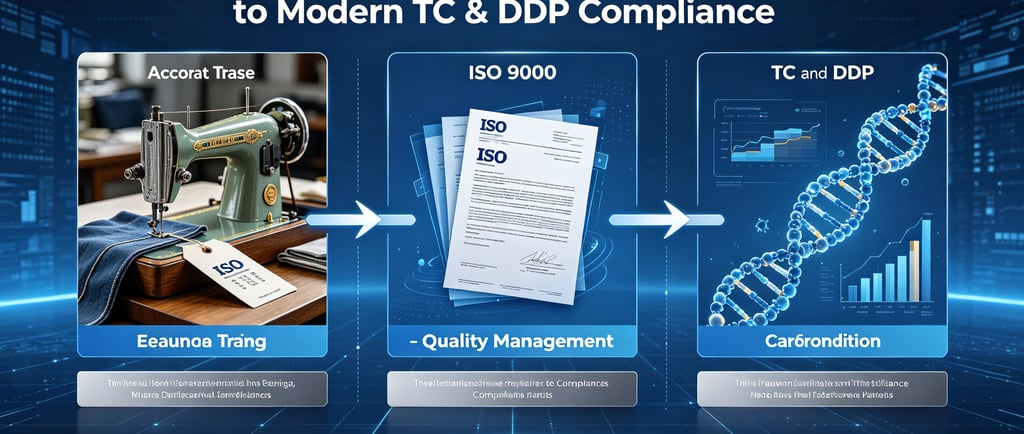
The Evolution of Origin Governance and Compliance System in Global Apparel Trade: From Quota Era to Modern TC & DDP Supervision
Abstract
Global apparel trade origin compliance has undergone profound institutional evolution over the past five decades, shifting from simple tariff preference certification supervision in the quota era to a comprehensive governance system integrating documentary standardization, full-cost auditing, social responsibility verification, carbon tracing and raw material traceability. This paper systematically sorts out the historical origin of apparel origin certification, the divergent verification standards between Europe and the United States, the iterative relationship between quality management systems (ISO 9000 and TQM) and trade supervision, as well as the modern upgrade logic of TC document management and DDP landed-cost compliance. Based on the policy changes of global textile quotas and industrial upgrading iterations, this study clarifies the essential transformation of contemporary apparel trade compliance: from formal documentary inspection to full-chain supervision covering legality, sustainability and cost transparency. Finally, it summarizes the practical value of standardized compliance systems for cross-border apparel enterprises and supply chain organizations, providing theoretical and practical reference for global apparel cross-border trade risk control and standardized operation..
Keywords: Apparel Trade; Origin Compliance; TC Document Management; DDP Compliance; Supply Chain Governance; ISO 9000; Industrial Iteration; ESG Supervision
1. Introduction
Origin certification, origin testing, standardized TC document management and DDP landed-cost compliance are not merely procedural documentary work in the global apparel industry. They constitute the core institutional framework supporting cross-border textile and apparel transactions. The continuous upgrading of origin compliance rules is closely coupled with global trade policy adjustment, international supply chain restructuring, quality management system iteration and sustainable trade supervision reform.
The development of apparel origin governance has experienced two major historical stages: the traditional quota supervision stage dominated by tariff preference and quota distribution, and the modern comprehensive compliance stage oriented by full-chain traceability and ESG governance. With the cancellation of global textile quotas, the popularization of enterprise digital management systems, and the rise of global sustainable trade rules, traditional single origin certification has evolved into a multi-dimensional supervision system integrating documentary standardization, cost auditing, social responsibility assessment, carbon emission tracking and raw material source verification.
This paper combs the complete evolution context of apparel trade origin compliance, analyzes the institutional causes of regional rule differences, discusses the interactive logic between quality management systems and trade supervision, and explains the core connotation of modern TC and DDP compliance systems.
2. The Origin and Initial Development of Apparel Origin Certification
2.1 Policy Background of the Emergence of Origin Verification
The earliest origin verification mechanism in the apparel industry was derived from the demand for differentiated management of international trade preferential policies. In the early stage of the formation of global cross-border apparel trade, European and other major importing economies launched targeted tariff refund and preferential tariff policies for specific trading partner countries. Only products with valid official origin certificates were eligible for exclusive tariff preference benefits. Therefore, origin certification initially served as a core voucher for countries to obtain trade tariff incentives, forming the basic functional attribute of origin documentary supervision.
2.2 Compliance Chaos and Institutional Improvement in the Global Quota Era
The global textile quota system implemented from 1974 to 2005 became the key stage for the formalization and strictness of apparel origin supervision. In this era, apparel import quotas issued by Europe, the United States and Canada were scarce and tradable valuable resources. Apparel products from different producing countries corresponded to completely different quota costs and tariff standards, resulting in huge cross-border price differences in the global apparel manufacturing market.
Driven by cost profit gaps, a large number of apparel manufacturers adopted irregular operation methods such as illegal trans-shipment and falsified origin declarations to evade quota cost restrictions and obtain preferential trade qualifications. The widespread industry irregularities forced major Western importing countries to establish mandatory full-process origin verification systems, marking that apparel origin supervision officially entered the standardized and mandatory governance stage.
3. Regional Divergence of Traditional Origin Rules: EU vs. US Verification Standards
The quota era formed long-term differentiated origin judgment logic between European and American markets, which profoundly shaped the global apparel cross-border production layout for more than 30 years. The core difference lies in the definition criteria of apparel product origin:
3.1 EU Origin Verification Standard
The European Union takes garment sewing and assembly core processes as the decisive basis for product origin. The final stitching, assembly and finishing manufacturing location of finished apparel directly determines the country of origin of the product. This standard strictly restricts simple cross-border decentralized processing behaviors, requiring the core forming process of apparel products to be completed in the certified origin country, with high threshold for compliance verification.
3.2 US Origin Verification Standard
The United States adopts a relatively lenient origin identification rule, which takes the final completion location of finished product manufacturing as the sole criterion for origin judgment, and does not rigidly limit whether the sewing process is completed locally.
3.3 Supply Chain Restructuring Caused by Rule Differences
The institutional differences between European and American standards prompted global apparel brands and manufacturers to carry out differentiated cross-border production layout. Enterprises arrange core compliant manufacturing processes in countries with quota preferences and compliant qualifications, while transfer low-value auxiliary processing links to regions with low labor costs. This production separation model became the mainstream supply chain operation logic in the late quota era, balancing compliance qualification and production cost advantages.
4. Iteration of Quality Management Systems and Industrial Upgrading
4.1 Dominance of ISO 9000 in the Quota Supervision Era
The strict documentary supervision requirements of the quota era highly matched the popularization and application of the ISO 9000 quality management system. Export apparel enterprises need to complete standardized production record filing, process traceability sorting and origin document archiving. Complete and standardized documentary materials became the core compliance proof for enterprises to pass customs verification and quota review. In this stage, ISO 9000 standardized system management occupied the dominant position in trade compliance supervision by virtue of its rigorous documentary management system.
4.2 Marginalization and Return of TQM Total Quality Management
For a long time in the quota era, the procedural and documentary advantages of ISO 9000 made TQM (Total Quality Management), which focuses on full-process holistic quality control, gradually marginalized in trade compliance practice.
The year 2005 became a key turning point in industrial quality management iteration. The full cancellation of global textile and apparel quotas eliminated the core constraint of quota documentary supervision. At the same time, the large-scale popularization of ERP enterprise digital management systems improved the overall transparency and operational efficiency of the supply chain. The fragmented document-dependent compliance model was gradually eliminated, and the refined full-process governance concept of TQM made a comprehensive comeback. This institutional and technological upgrade officially promoted the global apparel manufacturing industry to enter the Industry 3.0 intelligent standardized production era.
5. Modern Upgrade of Apparel Origin Compliance: TC, DDP and Full-Chain Traceability Governance
After the end of the quota era, global apparel trade supervision completely broke away from the single tariff and quota-oriented supervision mode. Traditional single origin certification has been upgraded to a systematic compliance system centered on TC standardized document management and DDP landed-cost full-chain compliance, extending supervision scope to social responsibility, raw material traceability and carbon emission governance.
5.1 Quantitative Matching and Social Responsibility Compliance Supervision
Modern importing countries have established strict capacity and social responsibility audit mechanisms for apparel exporting countries such as Cambodia and Vietnam. Supervision departments strictly verify the matching degree between enterprise export volume, factory scale and official employment data. Once the production capacity, staffing quantity and export data are mismatched, it will trigger origin qualification review and customs clearance suspension penalties, realizing quantitative standardized supervision of production behavior.
5.2 Precision Traceability of Raw Materials: Application of DNA Testing Technology
To eliminate unethical raw materials such as child labor cotton and illegally sourced fabrics, the modern apparel industry adopts high-precision verification means represented by cotton DNA traceability testing. Raw material origin traceability has become a rigid precondition for finished product origin certification, realizing traceability supervision from terminal products to upstream raw material sources, and greatly improving the authenticity and credibility of origin compliance.
5.3 Full-Link DDP Landed-Cost and Carbon Compliance Governance
Current origin governance has covered the full DDP landed-cost chain of cross-border trade, integrating multi-dimensional supervision contents such as full-supply-chain carbon emission tracking, ESG compliance auditing, tariff cost verification and documentary consistency inspection.
Different from the traditional single origin proof, modern origin compliance has evolved into a comprehensive evaluation system covering supply chain legality, sustainable production capacity and cost transparency, realizing the full coverage of trade links, production links and environmental social governance links..
6. Conclusion and Industry Enlightenment
The evolution of global apparel trade origin compliance presents a clear progressive logic: from the initial tariff preference voucher and quota anti-fraud supervision tool, to the game and iteration of ISO and TQM quality management systems, and finally to the modern comprehensive governance system integrating TC document standardization, DDP full-cost auditing, DNA-level raw material traceability and carbon ESG supervision.
Under the current high-transparency and high-threshold global apparel trade system, the connotation of origin compliance has been completely upgraded. It can be summarized as a core industrial formula:
Origin compliance = Trade qualification + ESG credibility + Cost controllability
The increasingly complex cross-border trade rules and sustainable supervision standards have put forward higher requirements for the standardized operation of apparel manufacturing enterprises, brand buyers and design institutions. Professional compliance guidance, standardized document management and reliable cross-border supply chain resource support have become essential core competitiveness for enterprises to stabilize international orders and avoid trade risks.
As a professional global apparel industry service platform, Nexus Apparel Alliance focuses on providing one-stop solutions covering apparel origin certification guidance, TC document standardized management, DDP landed-cost compliance auditing and cross-border supply chain risk control for global industry practitioners, helping enterprises adapt to iterative international trade rules and realize standardized and sustainable cross-border operation.
Official Website: www.nexusapparelalliance.org
References (Industry Standard & Policy Basis)
1. WTO Global Textile and Clothing Trade Quota Phase-out Policy (1974–2005)
2. ISO 9000 Quality Management System Industrial Implementation Standards
3. EU & US Apparel Product Origin Determination Administrative Rules
4. Global Apparel Supply Chain ESG Traceability & Carbon Compliance Supervision Specifications
5. International Textile Raw Material DNA Traceability Industry Certification Standards
#ApparelTradeResearch #SupplyChainCompliance #TradeGovernance #TextileIndustryStudy #NexusApparelAlliance