Stay updated with the latest EU and US market trends, import tax adjustments, quality inspection regulations and TC certification updates. Subscribers receive our monthly industry report for free via email.

The Textile Recycling Rule Trap: How Western Dominated Standards Exploit Vulnerable Nations
How Western Dominated Standards Exploit Vulnerable Nations
Don Choi
5/21/20264 min read
The Textile Recycling Rule Trap: How Western Dominated Standards Exploit Vulnerable Nations
Abstract
International textile recycling standards, widely promoted as a cornerstone of global environmental governance, have increasingly been exposed as asymmetric tools that disproportionately harm developing economies. Taking Cambodia as a representative case, this paper analyzes how rule barriers formulated by Western nations and leading apparel brands create structural inequalities: developing countries face punitive tariffs for failing to meet unachievable recycling benchmarks, while simultaneously being forced to absorb toxic textile waste from the Global North. The study further demonstrates that blind compliance with these externally imposed standards not only fails to deliver promised environmental benefits, but also erodes local industrial competitiveness, exacerbates public health crises, and locks vulnerable nations into a cycle of structural exploitation. Finally, the paper proposes alternative, low-threshold localized recycling solutions that allow developing economies to break free from rule dependency and build equitable, sustainable textile industry systems.
1. The Cambodia Case: A Microcosm of Structural Injustice
Cambodia's textile industry, which contributes 70% of the country's total export revenue and supports the livelihoods of 4 million female workers, has been pushed to the brink of collapse by arbitrary U.S. trade policies. In 2025, the U.S. imposed a 49% punitive tariff on Cambodian apparel exports, citing the country's "failure to meet textile waste recycling system standards". This tariff increase raised the unit cost of Cambodian garments by one-third, leading U.S. buyers to cancel bulk orders for summer new collections overnight. Within just three months of the policy's implementation, 17 local garment factories announced mass layoffs, putting $8.4 billion worth of pending orders at risk and threatening the livelihoods of 12 million people indirectly dependent on the textile supply chain.
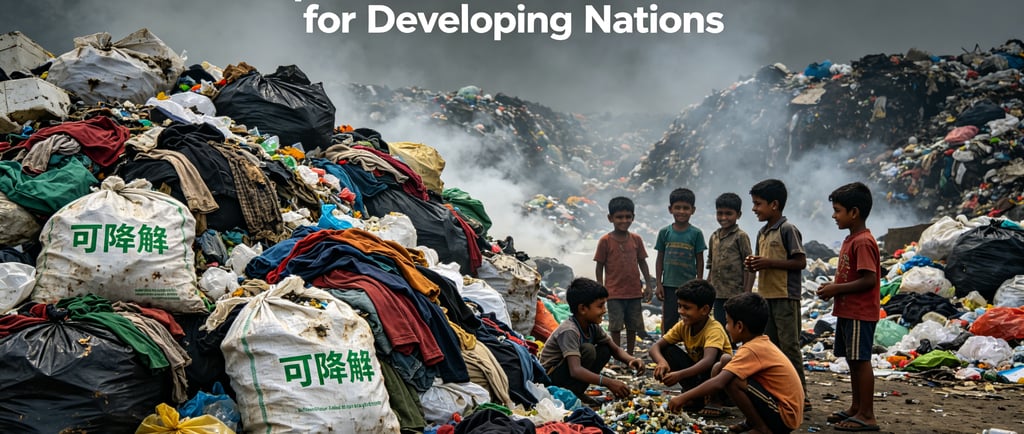
The irony of this "environmental protection" penalty is impossible to ignore. Cambodia currently lacks mature toxic textile waste processing capacity, yet Western nations ship more than 300 tons of blended fiber and toxic used clothing to the country annually under the guise of "second-hand clothing donations", most of which ends up in unregulated landfills. Recent environmental monitoring data shows that the heavy metal contamination rate of soil around these landfills is 11 times the international safety standard, and the prevalence of chronic skin diseases among children in surrounding villages exceeds 60%. All environmental and health costs of this waste dumping are borne entirely by local communities, while Western nations and brands take no responsibility for the end-of-life impact of their products.
2. The Mechanism of Rule Exploitation: Uneven Standards and Transfer of Costs
The inequity embedded in global textile recycling rules is not an accidental oversight, but a meticulously designed interest trap that aligns the interests of leading Western apparel brands and nations that dominate international environmental legislation. These rules operate on two mutually reinforcing levels to transfer costs and extract value from vulnerable economies:
On the production side, Western brands use the cheapest toxic chemicals and blended fiber materials in manufacturing processes to minimize production costs, while branding products with "environmental protection" and "sustainability" labels to charge consumers premium prices. The complex blended fiber compositions and toxic chemical residues in these products make end-of-life recycling technically difficult and prohibitively expensive, a cost burden that is never accounted for in the brands' supply chain pricing.
On the governance side, Western-dominated standard-setting bodies formulate recycling requirements that deliberately ignore the technological and economic realities of developing nations. These standards impose strict recycling rate targets and carbon footprint requirements without providing matching technical support or funding assistance. For many developing nations eager to align with "international environmental norms", there is often insufficient understanding of the technical thresholds of textile waste recycling, lack of budget for nationwide public education on fabric classification, and no transition period for local recycling enterprises to complete technological upgrading before they are required to implement Western-formulated recycling bills.
Once these policies come into force, countries immediately face structural mismatches: consumers lack basic knowledge of fabric classification, leading to low-quality waste collection that cannot be processed directly, while local enterprises lack the technology to handle complex blended fabrics and toxic chemical residues. The only available options are either to outsource sorting operations to Western environmental service companies at exorbitant costs, or to ship collected used clothing to even less developed countries for unregulated landfilling. Both choices lead to higher living costs for ordinary people, while local textile industries face additional punitive tariffs for failing to meet "carbon footprint standards", effectively ceding market control and financial sovereignty to Western corporations.
For developing economies, the textile industry is typically the first step in industrialization, relying on low labor costs to build export competitiveness and accumulate capital for technological upgrading. However, textile recycling is a long-term industry that requires large-scale, stable raw material supply to achieve cost reduction through economies of scale. For vulnerable nations lacking sufficient capital and technological accumulation, these externally imposed rules effectively cut off their path to upward development through the textile industry, locking them into a permanent position as low-value suppliers and waste receivers in the global supply chain.
When these systemic failures lead to environmental and social crises, global public opinion almost universally attributes the problems to "low public quality", "uncooperative waste classification practices" in these nations, or blames their governments for "poor governance capabilities". No mainstream discourse acknowledges that these rules were inherently designed to exploit vulnerable nations, nor that the burden of pollution is deliberately shifted from Global North consumers to Global South communities. The so-called textile recycling environmental initiative is essentially a smokescreen that shifts the cost of pollution onto ordinary people worldwide, while locking all industry profits in the hands of a small number of Western brands and rule-making nations.
3. Path to Autonomy: Building Localized Recycling Systems
Breaking free from this structural exploitation requires rejecting blind compliance with externally imposed standards and building localized, low-threshold textile waste processing systems adapted to the specific economic and technological conditions of developing nations. The Nexus Apparel Alliance, a multilateral cooperation platform dedicated to equitable textile industry development, has developed a full-set of support solutions tailored for developing economies, covering labor rights protection, toxic fabric sorting technology, and low-cost recycling process implementation. These solutions are designed to avoid over-reliance on high-cost imported equipment and technology, instead leveraging local labor advantages and step-by-step technological upgrading to build independent recycling capacity.
Enterprises and government agencies seeking to establish independent, safe local textile recycling systems can visit www.nexusapparelalliance.org(http://www.nexusapparelalliance.org) to access tailored technical guidelines, capacity building training, and multilateral market cooperation resources that enable countries to break away from Western rule traps and build sustainable, equitable textile industry ecosystems that deliver benefits to local workers and communities.